Middle East Maritime Risk Intensifies as Pressure Builds at Key Chokepoints
The Middle East’s two most critical maritime chokepoints are facing increasing pressure.
Disruption in the Strait of Hormuz has already forced carriers to adjust vessel networks. Now, the Houthis’ announced maritime embargo targeting Saudi shipping through the Bab el-Mandeb raises the possibility of further disruption to Red Sea trade.
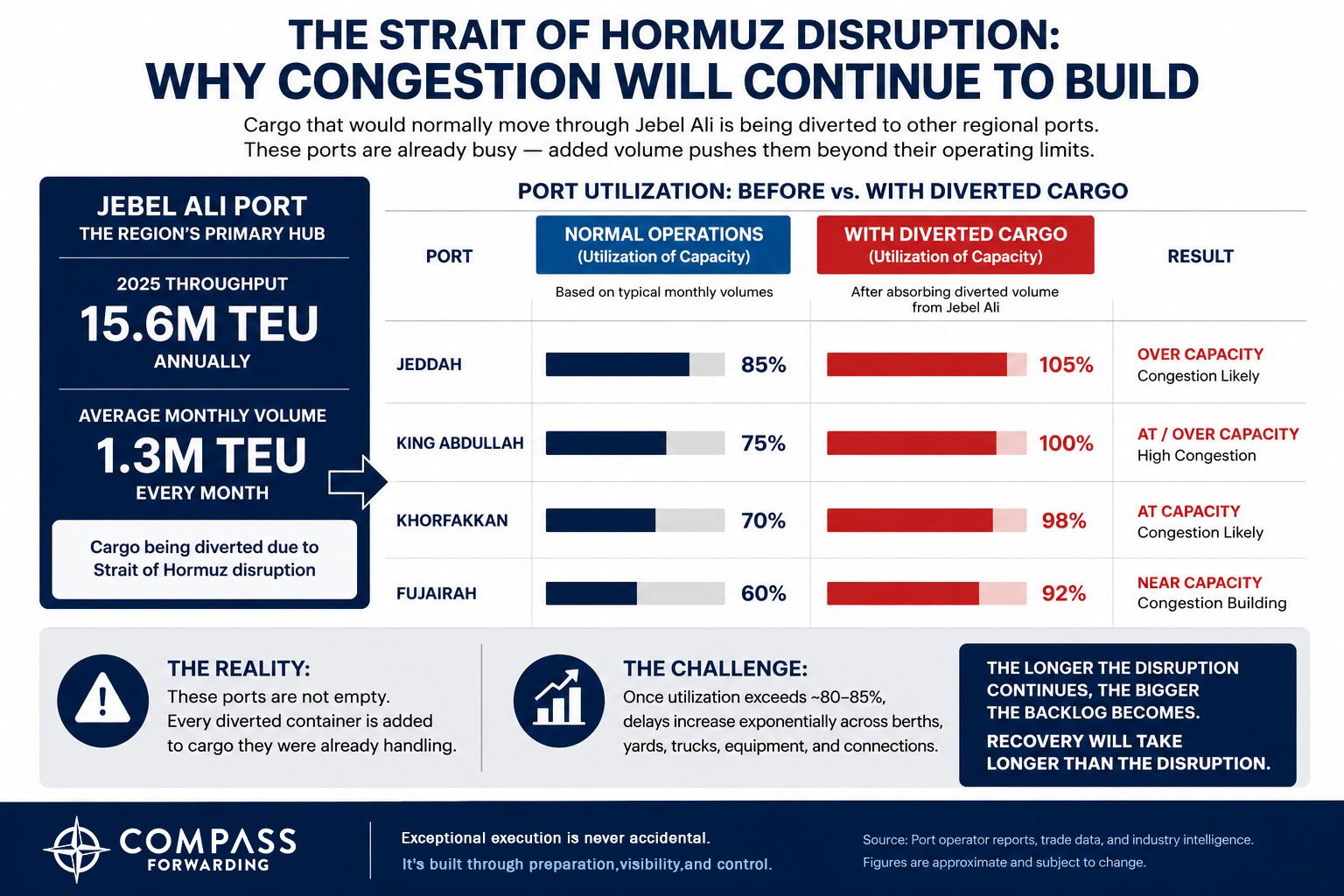
Jebel Ali normally processes approximately 1.3 million TEU each month. When cargo is diverted to neighboring ports, those containers are not filling unused capacity. They are being added to terminals already handling millions of containers of their own.
This added volume is placing severe strain on the regional logistics network. Ports absorbing diverted cargo are operating at or beyond practical capacity, causing congestion at berths, filling container yards, and increasing pressure throughout the supply chain.
As utilization rises, the effects compound:
Vessel queues grow
Container yards approach capacity
Equipment shortages become more acute
Trucking and rail networks face greater congestion
Feeder schedules become less reliable
Transit times continue to lengthen
Demurrage, detention, storage, and driver waiting costs increase
The concern is not total port capacity on paper—it is the amount of operating capacity actually available when vessels, containers, equipment, and inland transportation networks are all under pressure.
Every additional day of disruption adds to the backlog and extends the time required for recovery. If pressure continues at both the Strait of Hormuz and Bab el-Mandeb, shippers should prepare for longer transit times, greater schedule volatility, rising ancillary costs, and a slower regional recovery.
Compass Forwarding continues to monitor developments across the Middle East and work proactively with customers to mitigate disruption through routing alternatives, carrier strategy, and operational planning.